How Educational Boards Verify Original Certificates: Why Preserving Your Documents Matters
Learn how educational boards, universities, and employers verify original certificates and why damaged or improperly handled documents can create verification challenges. Discover the importance of professional lamination removal and document preservation with Spandan Lamination Remove Service.
ABROAD JOB APPLICATIONS
Viral Gala
7/2/20265 min read
How Educational Boards Verify Original Certificates: Why Preserving Your Documents Matters
Introduction: The Invisible Audit Behind Your Credentials
Earning an academic degree or a specialized diploma marks years of dedicated hard work, financial sacrifice, and mental energy. Naturally, when that crisp parchment document finally arrives, your immediate instinct is to shield it from the elements. To protect it from accidental fluid spills, dust, and tearing, many families head directly to local photocopy shops to seal these valuable records in thick plastic lamination.
While sealing your credentials seems like a logical way to preserve them, it is actually one of the most common administrative missteps an international applicant can make.
When you prepare to transition your life onto the global stage—whether applying for a higher degree in Canada, an engineering role in Germany, or an emergency work visa in the UAE—your laminated files will encounter an unexpected roadblock. Background verification vendors like the World Education Services (WES) and international embassies routinely reject laminated papers.
Understanding the intense forensic screening methods used during Background Checks on Wikipedia explains why a raw, unlaminated paper trail is crucial to securing your global ambitions.
Why Board Verification is Non-Negotiable
Educational boards, state departments, and corporate human resources divisions execute rigorous credential evaluations for one reason: to protect institutional integrity. According to data tracked on international immigration hubs like r/immigration on Reddit, document forgery, resume inflation, and fake marksheets are at an all-time high globally.
To combat this, validation officers do not simply read the print on a page; they treat your certificate as a high-security asset. They evaluate distinct, physical anti-fraud features built into the document that are instantly blocked or distorted by plastic lamination.
The Forensic Checklist: What Verification Officers Audit
When you submit an original certificate for apostille verification, embassy attestation, or university evaluation, background teams check several structural layers:
1. Tactile Embossed Seals and Intaglio Stamps
Authentic certificates typically feature raised, textured university seals or deeply stamped metallic foils pressed straight into the heavy paper cardstock. Lamination permanently fills in these structural variations, flattening the indentations and preventing officers from executing mandatory touch and texture audits.
2. Embedded Security Watermarks
Premium academic paper contains built-in internal watermarks and chemical safety grids that become visible only when held up against a direct light source or analyzed under ultraviolet (UV) lamps. Plastic coatings reflect intense light, creating a harsh glare that completely blind automated forensic cameras.
3. Fine-Line Microtext and Anti-Copy Grids
If you look closely at a genuine board marksheet, what appears to be a solid border line is often a continuous strand of microscopic text. Forgers cannot replicate this level of micro-printing. However, the industrial glue used in lamination pouches chemically bleeds into these ultra-fine lines over time, turning sharp microtext into an illegible blur.
4. Wet-Ink Signatures and Registrations
Verifiers inspect the natural pooling of ink, pen pressure variations, and the age of physical registrar signatures. Direct heat from standard laminators can cause these original ink markings to bleed or fade away entirely.
5. Mandatory Physical Attestation Placement
If your visa pathway requires formal consular authentication, officials must apply wet-ink stamps and high-security adhesive validation stickers directly onto the back of your original paper certificate. Glue and stamp inks cannot adhere to a slick, commercial plastic laminate pouch, causing immediate refusal at the consular window.
[Laminated Document] ➔ Blocks Wet Ink Adhesion ➔ Prevents Mandatory Government Attestation ➔ Visa Processing Halts [Delaminated Paper] ➔ Restores Tactile Texture ➔ Accepts Official Consulate Stamps ➔ Smooth Approval
The Severe Danger of "Do-It-Yourself" Home Delamination
When applicants realize that a laminated degree is actively delaying their immigration or study-abroad timeline, panic often sets in. Many attempt quick internet hacks to melt or slice the plastic off at home using household clothing irons, hair dryers, boiling kettles, or razor blades.
Document preservationists strongly warn against this.
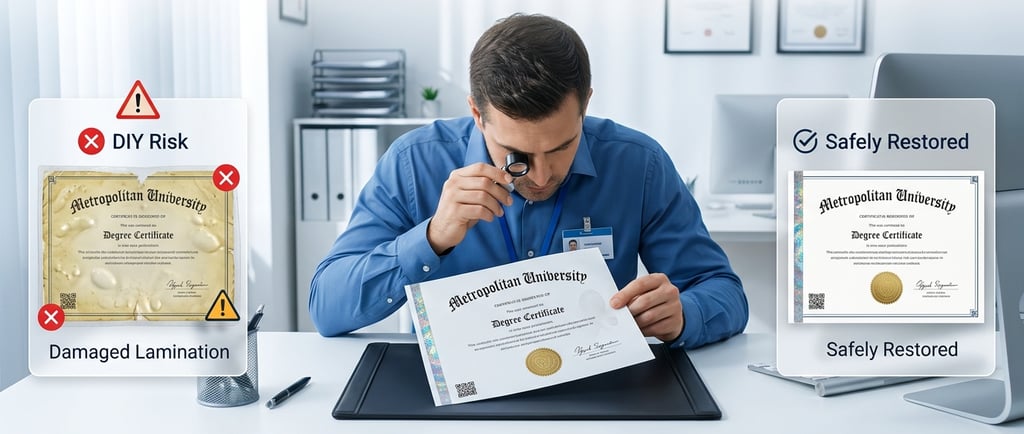
Commercial lamination pouches use a polymer adhesive that melts and fuses directly into the raw paper pores under intense heat and pressure. Pulling or tearing at that plastic backing at home forces the paper fibers apart internally. This process creates surface peeling, which forcefully lifts your grades, gold-foil logos, and original signatures right off the page, permanently defacing an irreplaceable certificate.
The Safe, Calibrated Technology Path to Document Restoration
To preserve fragile, one-of-a-kind academic papers, physical force must be bypassed entirely. At Spandan Lamination Remove Service, we deploy specialized, non-invasive thermodynamic and laser-assisted separation techniques to isolate and slide plastic layers away safely.
Our professional document restoration process ensures:
Micro-Fiber Evaluation: We carefully audit your document’s paper age, ink stability, and adhesive degradation under specialized lighting before running any procedures.
Precision Thermodynamic Calibration: Our advanced systems target the exact melting point of the underlying commercial glue layer, liquefying the bond without ever reaching temperatures that would scorch paper or fade sensitive inks.
Zero-Tension Separation: Once the adhesive bond is completely loosened, the outer plastic sleeves lift away naturally and effortlessly, ensuring there is absolutely zero stretching or tearing of fragile paper.
Archival Residue Cleanup: Any remaining sticky film is gently cleared away using safe, non-aqueous solutions, leaving your original marksheet looking beautifully clean, matte, and fully prepared for strict embassy scanning.
Essential Storage Tips to Maintain Your Portfolio
Instead of laminating your original career and academic assets, professional archivists recommend using safe, flexible protection methods:
Archival-Grade Polypropylene Sleeves: Store your certificates inside premium, acid-free, top-loading protectors. This keeps dust and fingerprints away while allowing reviewers to easily slide the raw document out for physical inspection.
Waterproof Document Folders: Keep your career portfolio organized flat within a rigid, weather-resistant document briefcase fitted with moisture-absorbing silica gel packets to prevent mold.
High-Resolution Digital Backups: Scan all unlaminated original documents at a sharp 600 DPI, saving clean PDF copies across secure cloud servers for frictionless online applications.
Recommended Viewing
Before assembling your verification folder, check out professional overviews of international credential processing to understand exactly what evaluation teams look for.
Search on YouTube: Look for "WES document submission guidelines for original certificates" or "VFS Global student visa documentation rules" to see firsthand why keeping your original raw paper completely intact is mandatory for international success.
Frequently Asked Questions (FAQ)
Q1: Why do educational boards flatly refuse to verify laminated original certificates?
A: Because commercial lamination can easily act as a shield to disguise counterfeit documents. It hides the texture of paper fibers, completely flattens embossed stamps, and alters how security watermarks react under UV verification lights, making it impossible to perform absolute authentication checks.
Q2: Can lamination be safely removed from a marksheet if the paper has already turned yellow or brittle?
A: Yes. Brittle, aged, or delicate papers are highly susceptible to tearing under physical stress. Our specialized technology handles these delicate fibers safely because it dissolves the adhesive bond thermally, removing the need for physical force, pulling, or scraping.
Q3: How can I send my laminated degree to Spandan safely if I live outside of Gujarat?
A: We manage high-security, doorstep document logistics across India. We partner directly with trusted networks like Blue Dart to arrange secure courier collection right from your home or office. Your documents are tracked transparently, restored safely by our experts, and securely shipped back with tracking.
Lock In Your Global Future: Contact Spandan Today
Your educational certificates represent a lifetime of dedication, hard work, and personal achievements. Do not gamble with your career milestones by testing risky internet home hacks. Let our specialized team restore your files to pristine, embassy-ready condition safely.
Founder & Immersive Professional: Viral Gala
Company Name: Spandan Lamination Removal Services
Direct Call / WhatsApp: +91 9920322366
Official Website: howtoremovelamination.com
Immersive Portals: 360vrphotography.com | 360vrphotography.in
Physical Processing Hub: Shop No - 29/A, ATC Trade Centre, Opp. Adalaj Step Well, Adalaj, Ahmedabad - 382421, Gujarat, India.