
Signs That Your Laminated Certificate Needs Professional Removal
Is your laminated marksheet or degree turning yellow, bubbling, or peeling? Learn the critical signs of lamination damage and why professional delamination is required to save your original documents for WES and embassy verification.
ABROAD JOB APPLICATIONS
Viral Gala
7/5/20266 min read
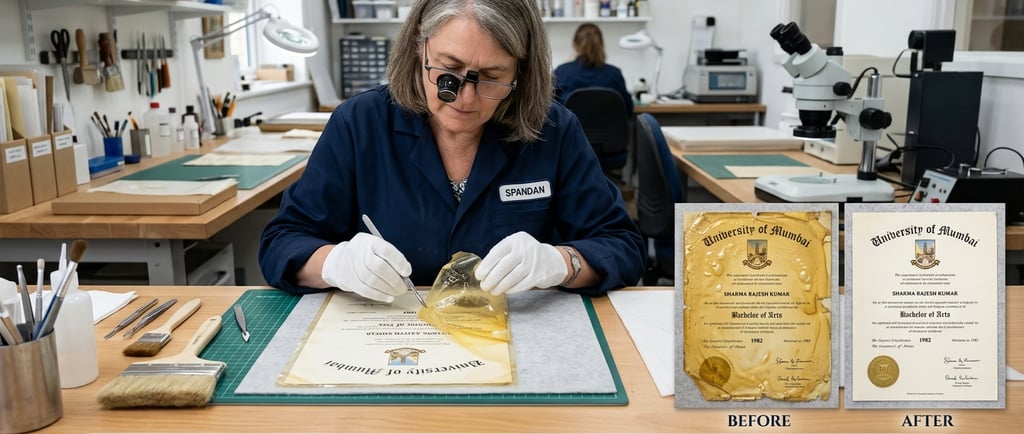
Signs That Your Laminated Certificate Needs Professional Removal
SEO Title: Signs Your Laminated Certificate Needs Professional Removal | Document Preservation
SEO Meta Description: Is your laminated marksheet or degree turning yellow, bubbling, or peeling? Learn the critical signs of lamination damage and why professional delamination is required to save your original documents for WES and embassy verification.
Introduction: The Ticking Clock Inside Your Documents
We laminate our most valuable milestones out of pure respect for the hard work they represent. The day you receive your university degree, high school marksheet, birth certificate, or property deed, your first instinct is to keep it safe forever. Tucking it inside a thick, glossy protective plastic sleeve seems like the ultimate way to weatherproof your achievements.
Unfortunately, commercial lamination is not a permanent preservation shield—it is a chemical clock ticking away on your shelf.
Over time, cheap plastic chemical chains break down, industrial adhesives degrade, and environmental heat takes its toll. What was meant to protect your documents quietly begins to destroy them from the inside out. Worse, when it comes time to take your career global, you quickly find out that embassies, background check agencies like WES, and top-tier employers flatly reject laminated papers for authentication.
If your certificates are currently sitting under plastic, you need to watch for the structural warning signs of degradation. Recognizing these symptoms early allows Spandan Lamination Remove Service to safely free your original papers before the damage becomes completely irreversible.
Why Lamination Slowly Evolves into a Document Hazard
To understand the warning signs, you have to understand the chemistry inside the pouch. Commercial laminators use high temperatures ($100^\circ\text{C}$ to $150^\circ\text{C}$) to melt a polymer plastic adhesive layer, squeezing it deep into the open, microscopic cellulose pores of your paper.
According to established archival principles of Paper Preservation on Wikipedia, mass-market plastics and chemical glues oxidize over time, turning highly acidic. This acid actively eats away at the paper fibers, making the original certificate incredibly brittle while fusing the ink permanently to the outer plastic film.
Eight Signs Your Laminated Document is in Critical Danger
1. The Plastic is Turning Yellow or Cloudy Brown
This is the most common early indicator of chemical decay. Yellowing happens when the plastic film is exposed to UV sunlight, ambient room heat, or low-quality acidic mounting adhesives. This discoloration drastically cuts down readability and signals that the chemical matrix of the glue is changing, making the paper beneath highly fragile.
2. Trapped Air Bubbles are Spreading
If you see small or large air bubbles forming beneath the plastic surface, the adhesive layer is actively failing and pulling away from the sheet. As these pockets shift with room temperature changes, they place uneven mechanical stress on the paper, often tearing off printed text, wet signatures, or official stamps directly surrounding the bubble.
3. The Outer Edges Have Begun to Peel Open
When the sealed edges of a lamination pouch lift or split, the protective vacuum is completely gone. Open edges act like a funnel, pulling in dust, ambient humidity, and airborne pollutants. On global expat communities like r/immigration on Reddit, users frequently share how open laminate edges allow moisture to seep inside, leading to permanent water stains and rapid mold growth.
[Peeling Plastic Edges] ➔ Traps Ambient Humidity ➔ Fungal Spore Breeding ➔ Irreversible Document Stains [Thermodynamic Delamination] ➔ Liquefies Fused Glue ➔ Lifts Plastic Cleanly ➔ Flawless Restoration
4. Wrinkles or Uneven Surfaces are Visible
A wavy, wrinkled, or warped surface is typically the result of bad calibration during the initial sealing process—either the print shop used excessive heat or ran the rollers too fast. These wrinkles crimp the original paper underneath, ensuring it will instantly rip down the crease line if anyone tries to pull the sleeve apart manually.
5. The Ink Text Appears to be Fading
If your marks or seals look significantly lighter than they used to, the chemical properties of the adhesive are actively reacting with the document's original print layer. If left unchecked, the ink can transfer entirely onto the plastic backing, leaving you with a blank sheet of paper if the lamination ever shifts.
6. White Cloudy Patches or Dark Fungal Spots
If moisture gets trapped inside the pouch during sealing, it creates a mini-greenhouse effect. This shows up as cloudy white patches or tiny black/green spots of mold. Fungus actively feeds on paper cellulose, causing the sheet to rot and dissolve into dust within the plastic framework.
7. Tiny Fractures and Cracks in the Plastic
As lamination film reaches the end of its lifespan, the synthetic polymers lose their flexibility and turn highly brittle. The plastic will develop sharp micro-cracks that can easily score, slice, or cut through critical holographic stamps and verification watermarks during basic handling.
8. Imminent University or Embassy Deadlines
Even if your lamination looks physically perfect, an upcoming international milestone is a major sign that the plastic needs to go. Global consulates and background screeners use high-definition optical scanners to inspect physical paper traits like embossed university seals and wet-ink signatures. Lamination blocks these tactile audits completely, meaning you must have it professionally removed before your submission window closes.
The Extreme Risk of "Do-It-Yourself" Home Hacks
When faced with tight visa deadlines, many applicants panic and try to remove the plastic at home using hair dryers, clothing irons, boiling kettles, or razor blades.
This is the fastest way to permanently ruin your credentials.
Because the commercial glue has spent years fusing into the paper pores, applying uncalibrated household heat or physical pulling causes surface delamination. The top layer of your document rips away entirely, leaving your text and grades stuck to the discarded plastic sleeve. Once a certificate is defaced, you are forced into a grueling bureaucratic pipeline of filing police reports and waiting months for the university board to issue a duplicate marksheet.
The Safe Solution: Spandan’s Thermodynamic Delamination Technology
To protect your irreplaceable academic and legal history, we eliminate physical force and aggressive peeling completely. At Spandan Lamination Remove Service, we use highly calibrated, proprietary thermodynamic technology to safely isolate and detach plastic layers.
Our specialized document restoration workflow guarantees:
Micro-Fiber Audit: We carefully examine your document's age, ink characteristics, and adhesive degradation under specialized lighting to determine the safest operating path.
Controlled Thermodynamic Targets: Our advanced machinery focuses precise energy fields to liquefy only the synthetic polymer glue layer, without ever reaching temperatures that could scorch paper or fade sensitive inks.
Zero-Tension Dissociation: Once the underlying bond is completely loosened, the outer plastic layers separate naturally and slide away effortlessly, ensuring there is absolutely zero pulling or tearing of fragile paper.
Archival Residue Cleanup: Any remaining sticky film is gently cleared away using safe, non-aqueous solutions, leaving your original marksheet clean, matte, and fully prepared for strict embassy scanning.
Recommended Viewing
Before risking your educational records on an untrusted home method, watch a live breakdown of how strictly verification networks examine physical paper.
Search on YouTube: Look for "How to handle original certificates for WES verification" or "VFS Global student visa documentation rules" to see firsthand why pristine, unlaminated paper trails are mandatory for global hiring and admissions.
Frequently Asked Questions (FAQ)
Q1: What should I do if a local print shop told me they can peel the lamination off easily?
A: Do not let them touch it. Standard copy centers do not use calibrated thermodynamic machinery; they use raw heat guns and razor blades. This carries an incredibly high risk of tearing your paper or lifting the ink cleanly off the page.
Q2: Can lamination be safely removed if the plastic has already turned completely yellow and brittle?
A: Yes. Brittle, yellowed lamination indicates that the plastic has turned highly acidic, making the paper beneath very fragile. Our non-destructive process eliminates physical tension completely, allowing us to safely lift the degraded plastic away without putting stress on the delicate sheet.
Q3: How can I send my laminated degree to Spandan safely if I live far from your center?
A: We manage high-security, doorstep document logistics across India. We partner directly with trusted networks like Blue Dart to arrange secure courier collection right from your home or office. Your documents are tracked transparently, restored safely by our experts, and securely shipped back to you.
Secure Your Global Career: Trust Spandan Today
Your educational certificates represent a lifetime of dedication, hard work, and personal achievements. Do not gamble with your career milestones by testing risky internet home hacks. Let our specialized team restore your files to pristine, embassy-ready condition safely.
Founder & Immersive Professional: Viral Gala
Company Name: Spandan Lamination Removal Services
Direct Call / WhatsApp: +91 9920322366
Official Website: howtoremovelamination.com
Immersive Portals: 360vrphotography.com | 360vrphotography.in
Physical Processing Hub: Shop No - 29/A, ATC Trade Centre, Opp. Adalaj Step Well, Adalaj, Ahmedabad - 382421, Gujarat, India.
