
What Happens if a Marksheet is Damaged During Delamination? Risks, Solutions & Expert Restoration Guide
Worried about a marksheet being damaged during delamination? Learn the common causes of damage, how to avoid costly mistakes, and why Spandan Lamination Remove Service is the trusted choice for safe, professional lamination removal of original educational documents.
ABROAD JOB
Viral Gala
7/14/20264 min read
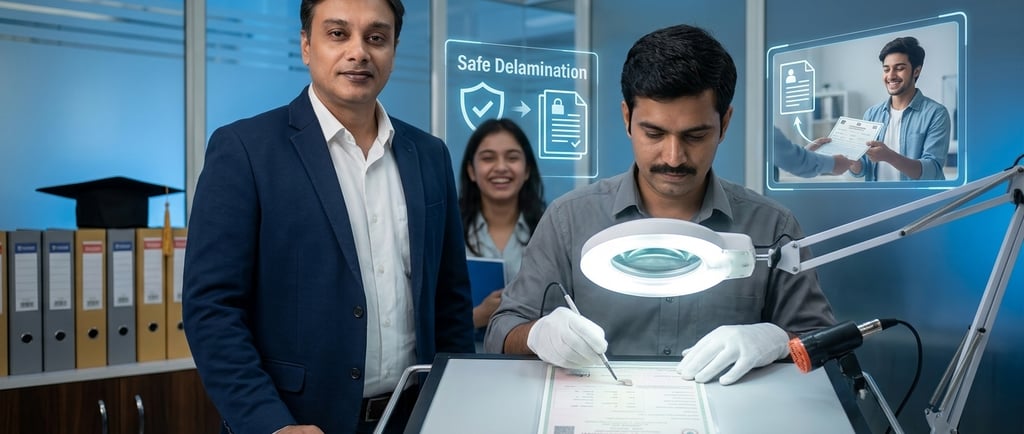
What Happens if a Marksheet is Damaged During Delamination? Risks, Solutions & Expert Restoration Guide
Your marksheet is far more than just a piece of paper—it is the tangible proof of your hard work and the ultimate master key for higher education, corporate jobs, visa applications, and international immigration.
Many students and professionals laminated their original certificates years ago, believing it was the best way to safeguard them against moisture, dust, and aging. However, a major shift has occurred: today, verification authorities—including foreign universities, credential evaluation bodies (like WES), and embassies—strictly demand non-laminated original documents to verify authentic paper texture, watermarks, and embossed stamps.
This leaves many facing a tricky dilemma, leading to the terrifying question: "What if my irreplaceable marksheet gets permanently ruined during the lamination removal process?"
The hard truth is that if handled incorrectly, irreversible damage can happen in seconds. However, by understanding the underlying chemistry and opting for professional techniques, you can safely recover your original document without a single scratch.
What Can Go Wrong During Delamination?
Lamination film isn't just wrapped around paper; it is thermally bonded to it using a heat-activated copolymer adhesive. When people try to forcefully pull, peel, or cut this plastic layer away, several catastrophic issues can occur:
Severe Paper Tearing (Splitting): Over the years, the adhesive sinks deep into the paper fibers. Pulling the plastic layer forcefully can split the paper right down the middle, leaving half your marksheet stuck to the plastic.
Ink Lift and Smearing: Cheap thermal lamination or intense DIY heat can cause the printed text, ink signatures, and official university stamps to liquefy and peel off right along with the plastic sheet.
Destruction of Security Features: Modern educational documents feature sensitive security assets like metallic holograms, micro-text borders, and embossed seals. These elements melt or tear easily under unstable conditions.
Adhesive Residue & Surface Distortion: Even if the plastic backing comes off, it frequently leaves behind a sticky, uneven layer of old glue. This residual goo collects dirt, turns brown over time, and makes it impossible to scan the document properly.
Why DIY Internet Hacks Are Extremely Dangerous
A quick online search will reveal dozens of tutorials suggesting household items to tackle this problem at home. Communities on platforms like Reddit's r/paralegal and expat forums frequently feature horror stories of people permanently destroying original birth certificates and transcripts using these exact hacks.
Here is why those popular DIY methods backfire:
The Hair Dryer / Clothes Iron Method: Applying uncontrolled heat can scorch old paper, char the borders, and cause the ink to run or bond permanently to the plastic.
The Steam Method: Introducing moisture directly to delicate, aged paper can instantly dissolve water-soluble inks, turning your official marksheet into a smeared watercolor painting.
Razor Blades & Scissors: Trying to slice open a tight edge lamination almost always results in accidental slips that cut straight through vital text or signatures.
Every document is distinct. Factors like paper GSM thickness, printing technology (laser toner vs. inkjet vs. offset), adhesive chemical makeup, and the physical age of the paper mean that a method that worked for someone else could completely destroy your specific certificate.
How Professionals Eliminate the Risk
Professional document restoration is a highly specialized craft that balances chemistry and patience. Instead of using blunt force, a professional process handles documents systematically:
1.Microscopic Structural Inspection:Risk Assessment.
We evaluate the exact paper type, ink stability, lamination thickness, and the condition of security holograms to map out a custom, non-destructive removal plan.
2.Controlled Plastic Separation:Chemical De-bonding.
Using precise, controlled thermal-chemical isolation techniques, the adhesive bond is gradually dissolved, allowing the plastic film to lift away naturally without pulling on the underlying paper fibers.
3.Micro-Adhesive Extraction:Deep Cleaning.
Any leftover sticky chemical residue is gently cleared from the surface using specialized solvents that preserve the original ink, signatures, and stamps.
4.Flattening & Document Curing:Final Preservation.
The fully restored document is carefully flattened under controlled pressure, removing aging wrinkles and restoring the paper to its clean, original texture.
Recommended Video: Real-World Document Delamination
To see exactly how a high-stakes lamination removal project looks when executed by an expert using professional tools, take a look at this detailed demonstration video on YouTube:
Video Title: How to Remove Lamination from Marksheet / Degree Certificate
Channel: Spandan Lamination Removal Service
Link: Watch the Professional Delamination Process on YouTube
Frequently Asked Questions (FAQ)
Can a marksheet that has been laminated for over 15–20 years be safely peeled?
Yes. While older documents require significantly more patience because the paper fibers grow fragile over time, professional de-bonding methods can still completely isolate the old adhesive without tearing the vintage paper base.
What should I do if I already tried to peel it at home and it started tearing?
Stop immediately. Do not attempt to fix it with tape, glue, or more heat. Leave the document exactly as it is, store it completely flat inside a hard folder, and hand it over to a professional document restorer. In many cases, the remaining section can still be salvaged safely.
Will the original stamps and university ink signatures fade after the process?
No, not when processed professionally. Our specialized techniques are engineered to selectively target the chemical structure of the lamination adhesive while leaving the underlying print ink, university stamp dyes, and fountain pen signatures completely untouched.
Trust Spandan Lamination Remove Service to Protect Your Future
At Spandan Lamination Remove Service, we treat your educational records with the extreme care they deserve. We understand that these documents represent years of dedication and are completely irreplaceable. Students and global professionals across India trust our team to prepare their paperwork flawlessly for study abroad programs, background checks, and immigration processing.
We Safely Restore:
SSC, HSC, & CBSE Marksheets
University Degree & Diploma Certificates
Official Transcripts & Passing Certificates
Birth, Marriage, & Registration Certificates
Historic Family Documents & Legal Papers
Don't risk your academic future on an unpredictable DIY experiment. Get in touch with us today to discuss your document's condition and get a safe, reliable evaluation.
Founder & Restoration Expert: Viral Gala
Company: Spandan Lamination Remove Service
Phone / WhatsApp: +91 99203 22366
Official Website: www.howtoremovelamination.com
