
Why Self-Removal Methods Can Destroy Important Documents: A Complete Guide to Safe Lamination Removal
Thinking of removing lamination from your degree, marksheet, certificate, or legal document yourself? Learn why DIY lamination removal can permanently damage important documents and why professional lamination removal services are the safest choice. Discover how Spandan Lamination Remove Service helps preserve your valuable documents.
ABROAD JOB APPLICATIONS
Viral Gala
7/1/20266 min read
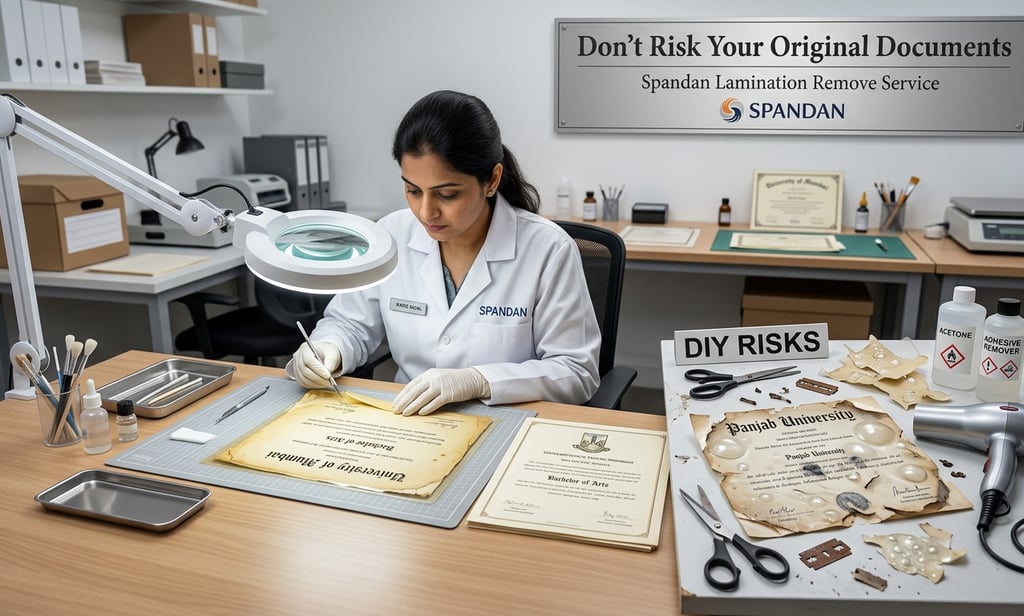
Why Self-Removal Methods Can Destroy Important Documents: A Complete Guide to Safe Lamination Removal
Introduction: The Hidden Trap of Document Preservation
It is one of the most common, well-intentioned mistakes people make. You receive an irreplaceable document—your university degree, a high school marksheet, your marriage certificate, or an essential property deed—and your first instinct is to protect it. To shield it from dust, moisture, and the wear and tear of time, you head straight to a local print shop to have it laminated.
For years, that document sits safely in your cupboard, encased in a thick, rigid sheet of plastic.
The trouble begins when your life expands globally. You apply for higher studies in Canada, an engineering role in Germany, a corporate work permit in the UK, or visa processing in the UAE. Suddenly, you encounter a strict, non-negotiable roadblock from an embassy, evaluation agency like WES, or government body: laminated documents are not accepted for attestation or verification.
Faced with tight visa deadlines and administrative pressure, many people panic. They search online for quick fixes and try "Do-It-Yourself" hacks using household items like hair dryers, clothing irons, or chemical solvents.
Unfortunately, this is the exact moment an irreplaceable document can be destroyed forever.
At Spandan Lamination Remove Service, we have spent decades restoring thousands of vital records. We have seen firsthand how a few minutes of an unverified home method can turn a perfectly repairable certificate into a shredded, illegible piece of paper that is beyond saving. Understanding the science and the risks behind lamination can save you from a permanent, heartbreaking bureaucratic nightmare.
Why People Risk DIY Methods (and Why the Internet Lies)
When a critical career or travel deadline is ticking down, the temptation to try a quick home trick is entirely understandable. People are frequently misled by highly edited internet videos or casual forum advice into believing that lamination is just a simple plastic sleeve that can be melted and peeled back like tape.
The truth is that every laminated document is a completely unique chemical puzzle. The type of polymer plastic used, the chemical formulation of the adhesive, the age of the lamination pouch, the paper weight, and the chemical composition of the original printing ink all dictate how the materials will behave. What worked on a cheap piece of modern photocopy paper in an online video will fail catastrophically on a delicate, textured 15-year-old university degree.
The Chemical Breakdown: Five Common DIY Hacks Destined for Failure
Commercial lamination does not simply sit on top of your paper; it forms a permanent bond. The process uses a machine to apply intense heat and pressure, liquefying an industrial hot-melt polymer glue and forcing it deep into the open, microscopic pores of the paper fibers.
Over time, this adhesive hardens and undergoes chemical degradation. Attempting to reverse this process at home using uncalibrated methods regularly results in five classic types of document destruction:
1. The Blow Dryer or Heat Gun Trap
While heat is required to soften lamination adhesive, household hair dryers or industrial heat guns provide completely uncontrolled, uneven temperatures. Excessive heat can instantly scorch paper yellow or brown, melt modern printer toner (causing text to smear into black blurs), and trigger severe warping, wrinkling, and air bubbling across the document's surface.
2. The Manual "Slow Peel" Disaster
Many people attempt to cut an edge, lift a small corner of the plastic pouch, and slowly pull it back with their fingers. Because the hardened industrial glue is tightly integrated into the paper's top layer, pulling the plastic forcefully rips the paper apart internally. This creates surface delamination, lifting away the paper fibers along with your grades, signature lines, and official registrar names.
3. The Clothing Iron Catastrophe
Placing a hot household iron over a certificate—even with a towel or cloth buffer—is one of the fastest ways to ruin it. The extreme, direct compression permanently bakes the plastic adhesive into the paper, often causing water-soluble inks to fade completely or transfer directly onto the plastic pouch, leaving a blank white sheet behind.
[Laminated Document] ➔ Aggressive Manual Peeling / Household Iron ➔ Fiber Fusing & Blurring ➔ Permanently Defaced Document [Laminated Document] ➔ Calibrated Thermodynamic Separation ➔ Adhesive Liquefaction ➔ Pristine Original Paper Restored
4. Harsh Chemical and Solvent Corrosion
Internet guides frequently suggest using industrial solvents like acetone, nail polish remover, or pure alcohol to dissolve the glue. These aggressive liquids easily break through the plastic, but they also permanently dissolve the official ink stamps, make fountain pen signatures bleed into illegible ink blots, and structurally weaken the cellulose fibers of the paper.
5. The Steam and Moisture Swelling Mistake
Holding a document over a boiling kettle or a steam iron to loosen the glue introduces severe moisture risks. Paper fibers naturally absorb water molecules rapidly, causing the document to swell, buckle, and wrinkle unevenly. Worse, if any moisture remains trapped within the paper layers, it creates a breeding ground for destructive mold and mildew growth.
What Makes Original Certificates Intact and Irreplaceable?
Modern background check vendors and immigration authorities enforce strict rules against lamination because it acts as a permanent shield hiding essential security markers. According to established security frameworks for Identity Document Security on Wikipedia, a document's raw physical characteristics are vital to confirming its legitimacy.
When an officer audits your file, they look for specific tactile features that disappear under plastic coatings:
Raised Embossed Seals: The distinct physical indentation left by a university press stamp.
Microtext and Watermarks: Tiny, high-security printing details and interior paper patterns that blur under plastic.
Original Wet-Ink Signatures: The natural variation in ink depth, pressure, and trailing lines left by a physical pen.
Official Attestation Placement: Embassies and consulates must apply their wet stamps and high-security adhesive stickers directly onto the raw back side of the original paper. Glue and ink cannot adhere to slick lamination plastic, as frequently noted on expat forums like r/immigration on Reddit.
If a DIY attempt compromises even one of these security elements, the document can be deemed invalid for international use—even if the text remains fully readable.
The Safe, Patented Technology Path to Document Restoration
To protect your irreplaceable educational and legal history, mechanical force and household heat must be bypassed completely. At Spandan Lamination Remove Service, we have spent over 30 years refining non-invasive, specialized document delamination using customized thermodynamic technology.
Our professional process isolates and removes plastic layers with absolute precision:
Micro-Fiber Audit: Before applying any treatment, we evaluate the age of the paper, ink properties, and adhesive degradation under specialized lighting to map out the safest possible approach.
Calibrated Thermodynamic Targeting: Our specialized systems apply precise, controlled energy fields to target the exact melting point of the underlying polymer glue, cleanly liquefying the adhesive bond without ever scorching paper or fading sensitive inks.
Zero-Tension Detachment: Once the adhesive bond is completely loosened, the outer plastic layers separate naturally and slide away effortlessly, ensuring there is absolutely zero pulling or tearing of fragile paper fibers.
Pristine Archival Cleanup: Any remaining sticky residue is gently cleared away using safe, non-aqueous solutions, leaving your original marksheet looking beautifully clean, matte, and fully prepared for strict embassy scanning.
Recommended Viewing
Before risking your educational records on an untrusted home method, watch a live breakdown of how strictly verification networks examine physical paper.
Search on YouTube: Look for "How to handle original certificates for WES verification" or "VFS Global document submission guidelines" to see firsthand why pristine, unlaminated paper trails are mandatory for global hiring and admissions.
Frequently Asked Questions (FAQ)
Q1: What should I do if a family member has already started a DIY removal and torn the corner of a marksheet?
A: Stop immediately. Do not try to tape it back down, do not apply an iron, and do not use glue. Keep the document completely flat inside a hard folder and consult a professional restoration service right away. In many cases, specialized systems can still safely loosen the remaining plastic and stabilize the torn fibers.
Q2: My degree certificate is over 20 years old and the lamination is deeply yellowed. Can it still be saved?
A: Yes. As lamination ages, it turns yellow and brittle because the plastic and adhesive become highly acidic. This makes the paper beneath incredibly fragile. Our non-destructive thermodynamic systems handle these delicate assets safely because they eliminate physical pulling entirely, lifting the plastic smoothly without stress on the paper.
Q3: How does your service manage document pickup and return if I live far from your center?
A: We provide secure, doorstep document logistics across India. We partner directly with trusted networks like Blue Dart to arrange high-security courier collection right from your home or office. Your documents are tracked transparently, restored safely by our experts, and securely shipped back with tracking.
Secure Your Global Journey: Trust Spandan Today
Your degrees, transcripts, and legal certificates represent a lifetime of hard work, personal milestones, and professional achievements. Do not gamble with your future by testing risky internet hacks. Let our specialized team restore your files to pristine, embassy-ready condition safely.
Founder & Immersive Professional: Viral Gala
Company Name: Spandan Lamination Removal Services
Direct Contact Number: +91 9920322366
Official Website: howtoremovelamination.com
Immersive Portals: 360vrphotography.com | 360vrphotography.in
Physical Processing Hub: Shop No - 29/A, ATC Trade Centre, Opp. Adalaj Step Well, Adalaj, Ahmedabad - 382421, Gujarat, India.
