
Why Universities Abroad Ask for Non-Laminated Original Certificates: A Complete Guide for Students
Many universities abroad require non-laminated original certificates. Learn the real reasons behind this rule, how lamination affects verification, and expert tips for safe document handling explained by 360 VR Photography.
REMOVE LAMINATION
Viral Gala
12/28/20252 min read
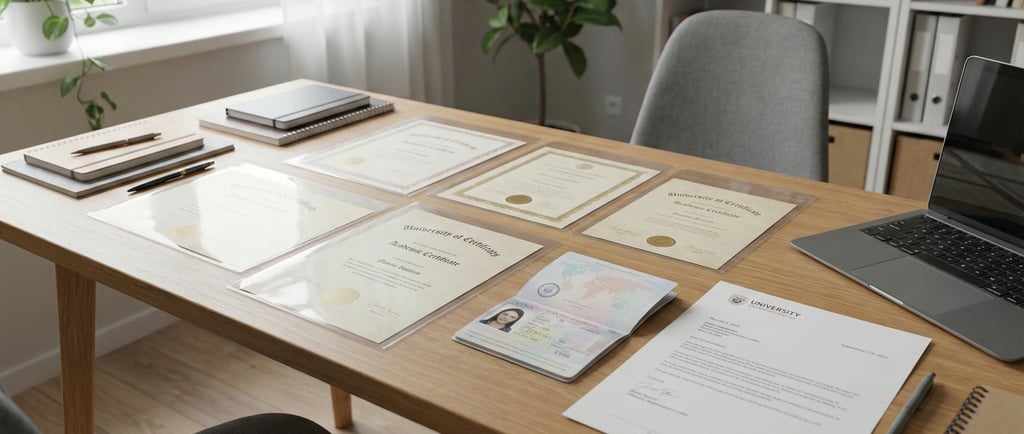
📄 What Are Non-Laminated Original Certificates?
Non-Laminated certificates are documents in their original paper form, exactly as issued by the board or university. This includes:
High School Mark Sheets (10th & 12th)
Degree & Diploma Certificates
Transcripts and Bonafide Letters
Birth & Marriage Certificates
❓ Why Universities Abroad Reject Laminated Certificates
1. Security Features Are Hidden
Original documents aren't just paper; they contain complex security features like watermarks, micro-printing, and embossed seals. Lamination flattens these "tactile" features and creates a glare that makes it impossible for admissions officers to verify authenticity.
2. The "Apostille" & Attestation Dead-End
If you are heading to a country like Germany or France, your documents must be Apostilled. This involves a legal sticker and stamp from the Ministry of External Affairs (MEA).
The Problem: Stamps and stickers cannot bond to plastic. Officials will refuse to stamp a laminated surface, meaning your document cannot be legalized for international use. [Learn more about the Apostille Convention on Wikipedia]
3. Suspicion of Fraud
According to discussions on [Reddit r/Indians_StudyAbroad], immigration officers sometimes view lamination as a way to hide "tampering." It raises the question: Are these grades original, or was a fake paper sealed under plastic to hide alterations?
4. Digital Verification Barriers
Many universities use high-end OCR (Optical Character Recognition) software to digitize your records. Lamination causes "hot spots" (light reflections) that distort text, leading to errors in your official university profile.
✅ What Students SHOULD Do Instead
Protect, Don't Seal: Use high-quality acid-free plastic sleeves or "L-folders." You can slide the document out whenever an official needs to feel the seal.
Professional Scanning: Scan your originals in 300 DPI before any travel.
If Already Laminated: Do NOT try to peel it off yourself. You will likely rip the paper or pull the ink off.
Expert Tip: Contact your university to request a Duplicate Original (unlaminated). It takes time but is the safest path.
🗣️ Frequently Asked Questions (FAQ)
Q: Will WES (World Education Services) accept laminated degrees?
A: WES usually requires documents in a sealed envelope sent directly from the university. However, if you must upload a scan, a laminated copy may be rejected if the glare obscures any text or seals.
Q: Can I remove lamination with a hair dryer?
A: Extremely Risky. Most modern lamination uses a thermal bond that fuses with the paper fibers. Heat can cause the ink to lift off entirely. Always seek professional help.
Q: Is a "True Copy" (Attested Photocopy) enough?
A: For initial applications, yes. But for Visa Interviews and Physical Enrollment, you must produce the unlaminated original.
🎬 Recommended Video Reference
To see exactly why lamination stops the attestation process in its tracks, watch this guide: Why You Should Never Laminate Your Certificates | Professional Advice
🌐 How 360 VR Photography Supports Your Journey
At 360 VR Photography, led by Viral Gala, we help students and institutions bridge the gap between physical documents and the digital world. We specialize in:
🎓 Virtual Campus Tours: Helping universities showcase their facilities to international students.
📄 Document Digitization: Secure, high-resolution scanning for study abroad portals.
🌍 VR Orientation: Immersive "pre-departure" experiences for students heading abroad.
Contact Viral Gala (360 VR Photography)
Website: 360vrphotography.in | 360vrphotography.com
Call / WhatsApp: +91 99203 22366
Email: info@360vrphotography.in