
Why Universities Abroad Ask for Non-Laminated Original Certificates: What Every Student Must Know
Applying to universities abroad? Learn why foreign universities ask for non-laminated original certificates, how lamination affects verification, and smart document-handling tips explained by 360 VR Photography.
ABROAD JOBABROAD JOB APPLICATIONS
Viral Gala
12/31/20253 min read
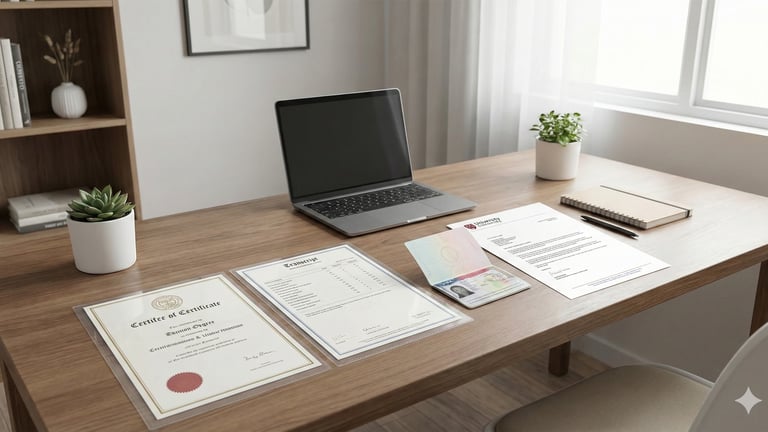
Original certificates must not be laminated
This requirement often surprises students and parents alike. After all, lamination feels like the ultimate protection for a valuable degree. However, for international universities, embassies, and verification agencies, lamination is actually a major hurdle that can lead to immediate rejection.
At 360 VR Photography, led by Viral Gala, we help students navigate the transition from physical paperwork to the digital world. Here is why non-laminated original certificates are mandatory for your global career.
📄 What Are Non-Laminated Original Certificates?
These are documents kept in their original paper form, exactly as they were issued by your board or university. Common examples include:
Academic mark sheets (10th, 12th, Semesters)
Degree and Diploma certificates
Transfer, Bonafide, and Migration certificates
Birth and Marriage certificates
❓ Why Universities Abroad Reject Laminated Certificates
1. Hidden Security Features
Original certificates aren't just paper; they are high-security documents. They contain watermarks, micro-text, and UV-ink elements that disappear or distort under a plastic layer. Furthermore, many official seals are embossed (raised). Lamination flattens these tactile features, making it impossible for a verification officer to "feel" if a seal is genuine.
2. The Attestation & Apostille Dead-End
If you are moving to a Hague Convention country (like the USA, UK, or Germany), your documents must be Apostilled. This involves a legal sticker and a physical stamp from the Ministry of External Affairs (MEA).
The Problem: Stamps and stickers cannot bond to plastic. Because officials cannot stamp the original paper through the lamination, they will simply reject the document.
Reference: Learn more about the Apostille Convention on Wikipedia.
3. Suspicion of Forgery
According to active discussions on [Reddit r/Indians_StudyAbroad], immigration and admission officers often view lamination with suspicion. It is a well-known tactic to try and make "phony" or altered documents look more genuine. By keeping your document unlaminated, you prove you have nothing to hide.
4. Scanning & OCR Accuracy
Lamination creates a "hot spot" or glare when scanned. This interferes with OCR (Optical Character Recognition) software used by university databases. If the computer can't read your grades accurately because of a plastic reflection, your application could be delayed.
✅ Safe Document Handling (What to Do Instead)
Use Transparent Sleeves: Invest in high-quality, acid-free plastic sleeves or "L-folders." These protect from dust and moisture but allow the document to be slipped out for physical inspection.
Store in Waterproof Folders: While traveling, use a hard-shell waterproof file to prevent bending or water damage.
High-Resolution Scanning: Before you do anything else, create 300 DPI color scans of all your originals.
If Already Laminated: Do NOT try to peel it off with a hair dryer or iron. You risk pulling the ink off the page.
Pro Tip: The safest route is to contact your issuing university for a Duplicate Original certificate.
🗣️ Frequently Asked Questions (FAQ)
Q: Is a "True Copy" (Notarized Photocopy) enough?
A: For initial application stages, often yes. However, for Visa Interviews and physical enrollment at the university, you must present the unlaminated original.
Q: Will a laminated certificate affect my US Visa?
A: Yes. Consular officers need to verify the authenticity of your documents. A laminated certificate can lead to extra scrutiny or a request for a fresh, unlaminated copy.
Q: Does this rule apply to birth certificates too?
A: Absolutely. Any document that requires an MEA stamp or Embassy attestation must be unlaminated.
🎬 Recommended Video Reference
To see why the physical texture of a document is so important to officials, watch this guide: Why You Should Never Laminate Your Certificates | Expert Document Advice
🌐 How 360 VR Photography Supports Your Journey
At 360 VR Photography, we bridge the gap between tradition and technology. We assist educational institutions and consultants with:
🎓 Virtual Campus Tours: Helping students explore international universities from home.
📄 High-Quality Digitization: Secure, crystal-clear scanning for study-abroad portals.
🌍 VR Orientation: Immersive experiences for students to understand their new life abroad.
Contact Viral Gala (360 VR Photography)
Call / WhatsApp: +91 99203 22366
Email: info@360vrphotography.in
