
Why Universities Reject Laminated Certificates (And How to Fix It)
The Educational Focus: "Planning to study abroad? Discover why foreign universities and visa officers reject laminated certificates and how to protect your documents the right way."
ABROAD JOB
Viral Gala
12/9/20253 min read
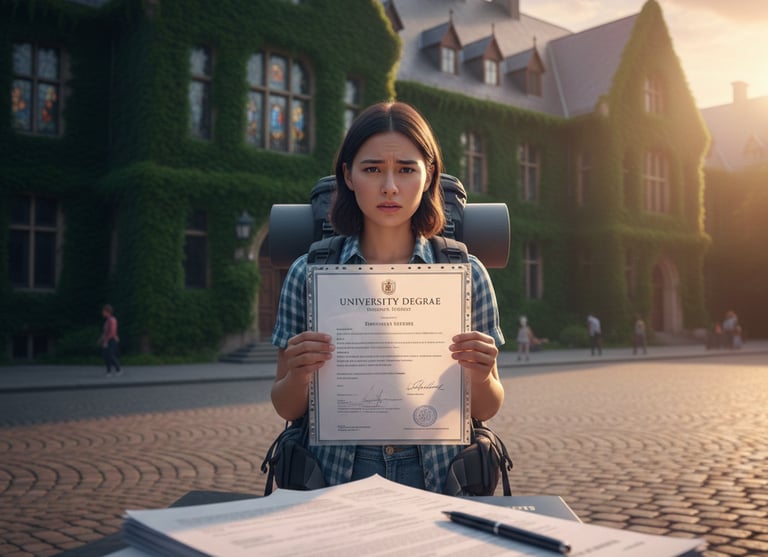

Why Universities Abroad Ask for Non-Laminated Original Certificates (And How to Fix It)
Studying abroad is a massive milestone. It’s a dream fueled by late-night study sessions and years of hard work. But often, standing between you and that dream is a mountain of paperwork.
One requirement that catches almost everyone off guard is the strict rule from foreign universities: Non-laminated, original certificates only.
It feels counterintuitive, doesn't it? You laminated that degree to protect it from coffee spills and tears. It was an act of care. But to an admissions officer in the UK, Canada, or the USA, that plastic shield is a red flag.
Here is the human perspective on why this happens, and how to navigate it without panic.
❤️ A Human Perspective: The "Plastic Suit" Analogy
Imagine you spent years earning your degree. You brought it home, proud and relieved, and immediately laminated it to preserve it forever. That makes total sense.
But think of it this way: It’s like showing up to a job interview in your best suit—but wearing a clear plastic rain poncho over it.
To you, it looks like "preservation." To the interviewer, it looks like you are hiding something or that the suit (the certificate) isn't real. It miscommunicates your authenticity.
For a foreign admissions officer, certificates are not just pieces of paper; they are legal testimonies. They expect to touch the paper, feel the embossed seal, and stamp it directly. When you seal it behind plastic, you strip the document of its "human" element—its texture and its accessibility.
🔎 The Technical Reality: Why Lamination is a Problem
When overseas admissions officers or credential evaluators look at your documents, they are looking for specific security features that lamination destroys or obscures:
Tactile Verification: They need to feel the paper texture and the raised impression of the university seal.
The "Apostille" Issue: For international validity, documents often need an Apostille (a specialized international attestation). Officials need to apply a physical stamp or sticker directly onto the back of the original document. Lamination makes this impossible.
Fraud Detection: Lamination is unfortunately a common tactic used to hide alterations on forged documents. A laminated document is automatically treated with suspicion.
What the Community Says: You aren't alone in this frustration. A quick look at discussions on r/StudyAbroad on Reddit shows hundreds of students realizing too late that their laminated mark sheets are being rejected for visa applications. It is a global standard, not just a picky university rule.
✅ Best Practices — What You Should Do
Stop! Do not laminate: If you have just graduated, buy a high-quality document folder or a protective sleeve instead.
Check the Guidelines: Always verify the admission guidelines of your destination university. They often explicitly state: "Submit official transcripts in a sealed envelope" or "Originals must be unaltered."
The "Fresh Copy" Route: If your documents are already laminated, contact your university or board immediately to ask for a duplicate or re-issue. This is the safest path.
Professional Help: If a re-issue isn't possible, you may need Delamination.
⚠️ Warning: Never try to iron it off or peel it at home. You will rip the ink off the paper. This requires a chemical process handled by professionals.
🎥 Watch: Understanding the Risk
Here is a helpful video that visualizes why lamination causes issues during the verification process and how professionals handle these delicate documents.
❓ Frequently Asked Questions (FAQ)
Q: Why can't I just send a color photocopy? A: Photocopies lack security features like watermarks and embossed seals. Foreign authorities (like WES or <strong>World Education Services</strong>) need to verify the source, which is often impossible with a copy.
Q: My certificate is already laminated—am I doomed? A: Not at all. Thousands of students face this. Your first step is to apply for a duplicate. If that fails, seek professional delamination services to restore the original.
Q: Can I laminate a photocopy for my personal use? A: Yes! This is actually the smartest approach. Laminate a clear color copy for your wall or wallet, but keep the original "naked" and safe in a folder for official use.
📝 We Can Help You
If you are stuck with laminated certificates and need to prepare them for study abroad, or if you need guidance on document handling and delamination, reliable help is available.
Do not risk damaging your life's work by peeling it yourself.
Contact: Viral Gala 📞 +91 99203 22366 🌐 www.howtoremovelamination.com